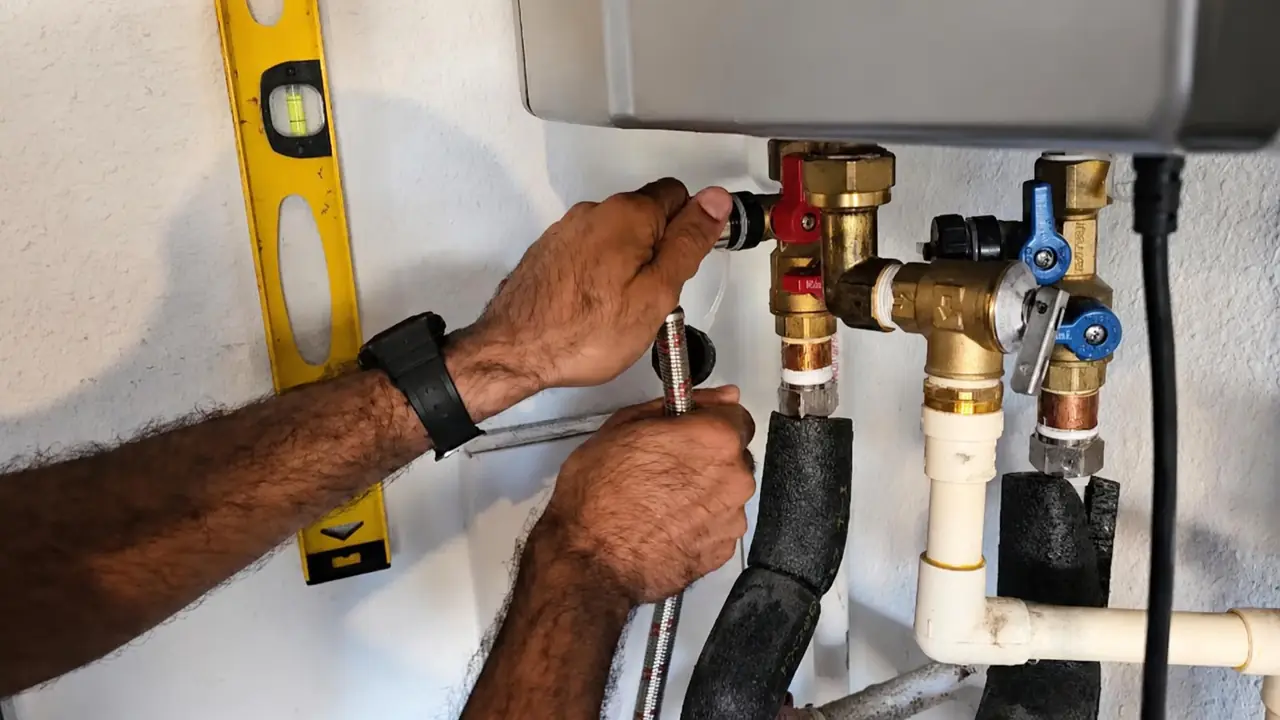
What the relief valve does
A temperature and pressure relief valve, often called a T&P valve, is the last line of defense on a water heater. If pressure or temperature rises past a safe level, the valve opens and lets water escape. It should never be capped, plugged or removed.
Tank heaters nearly always have one. Tankless units hold far less water, so the design differs, and some have a pressure relief valve on the water side while others depend on the house system. Your manual and the label on the unit say what yours has. If anything is unclear, ask a plumber rather than guess.
Why a valve drips
| Cause | What happens | Fix |
|---|---|---|
| Thermal expansion | Heated water expands in a closed system and pressure spikes | Add or service an expansion tank. |
| High supply pressure | Street or house pressure exceeds the valve's setting | Install or adjust a pressure reducing valve. |
| Worn valve seat | Valve no longer seals after years of use | Replace the valve. |
| Mineral buildup | Scale keeps the valve slightly open | Replace the valve. |
| Overheating | Controls fail and temperature climbs | Shut off and call a plumber. |
A slow drip after a hot water draw is often thermal expansion. A constant stream is a warning that something is wrong. Keep the discharge pipe open and pointed downward, and never close it off to stop a drip.
Valve dripping and you are not sure why? Call and we will test pressure.
Call (301) 936-0389Testing the valve safely
Many manufacturers suggest lifting the valve lever briefly once a year to see that it moves and that water flows from the discharge pipe. Do this only if the manual says it is safe for your model, keep a bucket under the pipe and expect hot water. If the valve does not reseat and keeps dripping, it needs replacing.
Never test a valve by holding it open for a long time, and never use a tool to force it. Pressure relief valves are designed to last a long while, but they wear out, especially in homes with high water pressure or heavy mineral content.
- Keep the discharge pipe open, pointing down and not threaded at the end.
- Replace a valve that leaks after being tested.
- Install an expansion tank if the house has a check valve or a pressure reducing valve.
- Have pressure checked whenever a relief valve starts to drip.
Replacing a relief valve
Replacement is a short job for a plumber. The water is shut off, the heater is drained to a level below the valve, the old valve is removed and a new one of the same rating is installed, with the discharge pipe reconnected. Never swap in a valve with a different pressure or temperature rating, and never plug the opening to stop a leak.
Expansion tanks and pressure reducing valves
Many houses have a backflow preventer or a pressure reducing valve on the incoming line, which turns the plumbing into a closed system. Water has nowhere to expand, so pressure rises each time the heater runs. A small expansion tank on the cold line absorbs that growth and spares the relief valve.
A pressure reducing valve brings street pressure down to a safe level for the house. When one fails, pressure climbs, fixtures wear out faster and relief valves start to weep. We test pressure with a gauge before suggesting parts.
What you can safely check
- Look for moisture at the end of the discharge pipe.
- Note whether the drip happens only after hot water use.
- Check the discharge pipe for kinks or caps.
- Do not twist or pry the valve lever repeatedly, which can leave it leaking.
Pressure and your water supplier
Water pressure at your house depends on your supplier and your location. In Rockville the City treats and distributes water to about 70 percent of the city, and WSSC Water serves the rest, so check your bill to see who supplies you.
We do not quote a standard pressure for Rockville. A gauge on an outdoor hose bib gives you a real reading, and a plumber can read it with you. For safety work on the heater, WSSC Water is the plumbing inspection agency for Montgomery County.
Source type: City utility supply information and WSSC plumbing inspection guidance
If a drip turns into a failure, our pages on water heater repair and replacement explain next steps, and our Gaithersburg page and Aspen Hill page cover nearby homes.
Where this comes from. Valve ratings and discharge rules come from the heater manufacturer's manual. According to Montgomery County's permit guidance, plumbing permits are handled through WSSC Water, which has its own Plumbing and Fuel Gas Code. Check with WSSC Water for what your job needs, because rules change.
Questions homeowners ask
It depends on the model and the installation. Your manual and a plumber can confirm what your system requires.
A slow drip may be thermal expansion. A steady stream is a warning, so shut off the heater and call a plumber.
No. Capping a relief valve removes a safety device and can cause a dangerous pressure build-up.
Most of the city is supplied by the City of Rockville, and WSSC Water serves the rest. Your water bill shows which.