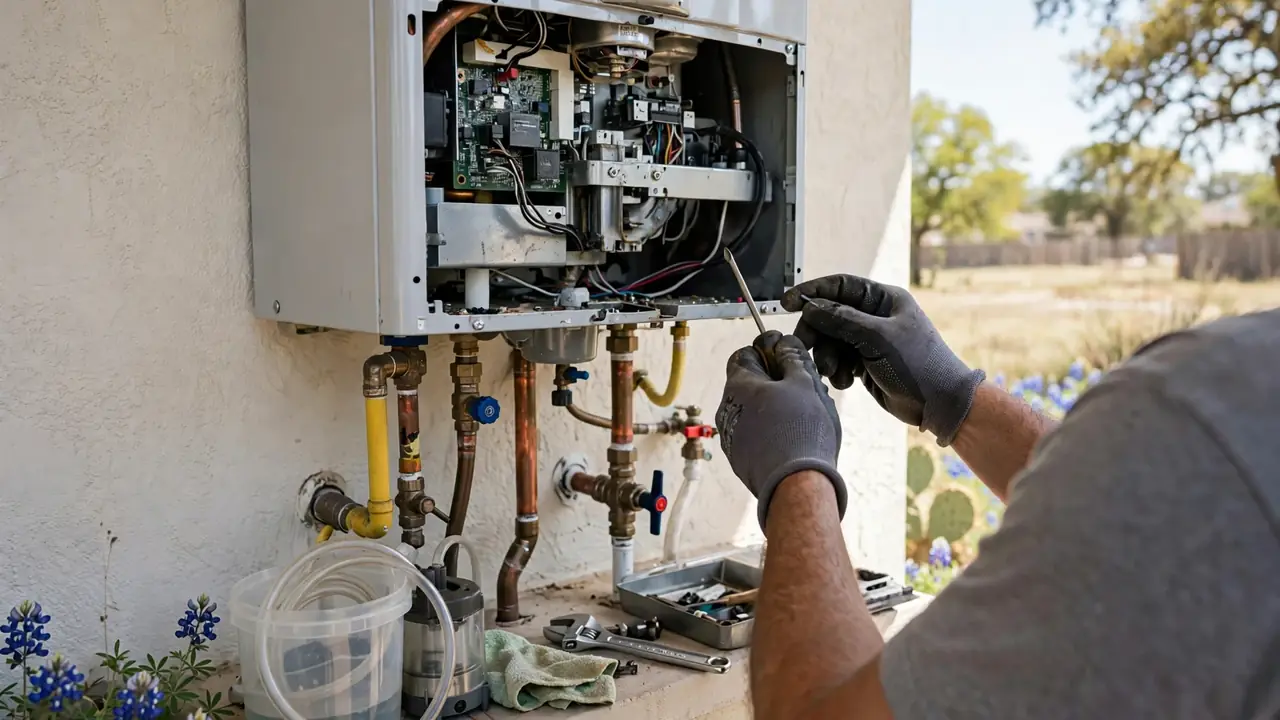
How an outdoor tankless unit works
An outdoor tankless heater is built with a weatherproof cabinet and an exhaust system that vents straight out of the unit, so no flue passes through the house. Gas and cold water connect from the wall, and hot water returns inside. Many homeowners like that it frees a utility closet.
The unit heats water only while a tap is open. That is why it saves space, and why its performance depends on gas supply and water flow. If you are comparing it with a stored tank, read our page on tankless water heaters for the broader trade-offs.
Freeze protection is the main concern
Most outdoor models include built-in freeze protection, typically an electric heater that turns on when the cabinet gets cold. That protection depends on constant power. If a winter storm cuts electricity, the heater can stop protecting the unit while the pipes on the wall go unprotected.
- Insulate the exposed supply and return pipes on the wall.
- Confirm the unit has an electric freeze heater and that it is on a dedicated circuit.
- Know how to drain the unit and its pipes if you will be away in a hard freeze.
- Do not shut the electric supply off in winter for convenience.
| Question | Outdoor unit | Indoor unit |
|---|---|---|
| Floor space used | None inside | Closet or wall space. |
| Freeze risk | Higher, needs protection | Low. |
| Venting | Short, built in | Wall or roof vent. |
| Service access | Exposed to weather | Easier, indoors. |
| Gas line | Must reach exterior wall | Interior route. |
Wondering whether outdoor tankless fits your house? Call and we will check the gas route.
Call (301) 936-0389Questions to ask before you choose an outdoor unit
Outdoor tankless units are sold on convenience, so it helps to turn the conversation toward conditions. Where will the unit sit, how long is the gas run, and what happens to it during a power failure in January? A dealer who skips these questions is selling a product and not a solution.
- Is the unit rated for outdoor use, and does it include freeze protection?
- How far is the gas meter, and is the gas line large enough?
- Where does the condensate go in winter, and can it freeze?
- What is the maintenance schedule, and who services it?
- What clearance does the unit need from windows and doors?
Take photos of the planned wall, the meter and the nearest outlet. They make a quote more accurate and spare you a second visit. If the wall faces prevailing wind, ask about a wind guard, since gusts can disturb the burner.
Maintenance for outdoor units
Outdoor tankless heaters need a yearly check. Clear leaves and debris from the intake and exhaust, inspect the freeze protection, flush the heat exchanger and look at the venting for corrosion. Keep snow and mulch from piling against the cabinet, and keep the area around it open so a technician can work.
Gas supply and clearances
Tankless burners need a larger volume of gas than a tank. The line from the meter to the exterior wall has to be sized for the full load, and the unit needs clearance from windows, doors and air intakes. We check pipe size and meter capacity before recommending a model.
The location should also be easy for a technician to reach. Yearly descaling and inspection are part of owning a tankless heater, and a crowded or hidden spot makes that harder. A good spot is on the side of the house, away from walkways, with room to work.
When indoor is the smarter choice
If your gas line runs to the basement and the unit would sit near a vent path anyway, indoor is often simpler. In a house with a recessed, windy or shaded wall that stays cold, an outdoor unit works harder to stay warm. When in doubt, we walk the house before quoting, and for a planned job see water heater installation.
Permits and who inspects
Plumbing and fuel gas work in Montgomery County is inspected by WSSC Water, which has its own Plumbing and Fuel Gas Code. The county's permit list directs plumbing permits to WSSC, and it advises residents who live in a municipality or HOA to check their local rules as well.
Rockville is a municipality, so check city and HOA requirements for anything attached to the outside of the house. Confirm the details with the utility and the inspection agency before work begins.
Source type: Montgomery County permit guidance and WSSC Water plumbing inspection
For nearby homes with newer exteriors see our Potomac page, and for planned changes near Derwood see our Derwood page.
Where this comes from. According to Montgomery County's permit guidance, plumbing permits are handled through WSSC Water, which has its own Plumbing and Fuel Gas Code. Check with WSSC Water for what your job needs, because rules change.
Questions homeowners ask
It can if freeze protection fails. Built-in heaters rely on power, and exposed pipes need insulation.
No. Outdoor models vent directly out of the cabinet.
Plumbing and fuel gas work is inspected through WSSC Water. Rockville is a municipality, so check city and HOA rules too. We confirm before work begins.
Not necessarily. It saves venting work but may add a longer gas run and freeze protection.